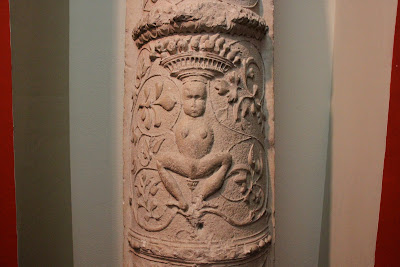
Hues of the yellow light dispersed on the hollow eyes of the Zemi, standing like a warrior enclosed in a glass frame, the large eye sockets of the mahogany figurine holds centuries of Jamaica's history buried in them. The Zemi, which were worshipped by the Taino, are part of the selection of the rich heritage housed in the Art in Jamaica, c. 1000-c. 1900 section at National Gallery of Jamaica in downtown Kingston. "These (artefacts) are priceless and (are a) deep-rooted representation of Jamaica's history," said Monique Barnett-Davidson, curatorial assistant in the education department at the National Gallery. The diversity of the exhibits - like the country's motto 'Out of Many, One People' is a confluence of cultures - commencing from the early Taino artefacts made of wood, chiselled into the early Spanish-Persian influence in limestone, dissipating on to canvas in geometrical perfection and symmetrical symphony. This artistic journey ...
Members of Jamaican Folk Singers Published September 30, 2012 Sunday Gleaner “Folk songs are all about the life of Jamaican folks and valuable life lessons,” says Christine MacDonald Nevers. “And through folk music, we are passing these lessons to the people.” MacDonald Nevers, the musical director of the Jamaican Folk Singers, believes this art form is a mirror reflecting the Jamaican society, its culture and people, and is constantly evolving. “Change happens, and we should evolve with change, and through folk music, we are passing this message of change, (and) at the same time, emphasising the need to preserve our heritage,” she informed. From deep-rooted traditions to the modern paradigms, folk music and musicians are striving to weave a storyboard that intricately interlaces the two in a mix of music. This is reflective of the Jamaican Folk Singers, which is a non-profit singing group founded in 1967 by Dr Olive Lewin, whose members come from diverse...
Carl Lauder started working when he was a teenager and has since kept going Carl Lauder gently pulls out a record from its cover, dusts it and places it on the turntable, gently placing the needle on the groove, and lets the player turn out the sounds of music. Lauder is not a fancy disc jockey, in Randy's Record Mart in Parade, downtown Kingston - a melting pot of the city - he is striving to preserve and keep a musical tradition alive. "I have been working here (at Randy's) since I was a teenager," said Lauder, as he meticulously wiped traces of dust from an LP (long play) record. "I love what I am doing and this gives me the motivation to carry on." Lauder is a lone soldier, treading the path to keep the romance of analogue tones alive in the 21st-century digital world. Randy's is testimonial to the crests of the island's musical history. Sounds of silence: A stack of vinyl in the recording studio Established by Vincent 'Randy...
+for+Gleaner+article.JPG)

Comments
Post a Comment