Posts

Showing posts with the label UNESCO World Heritage Site

Konark – an ode to the Sun God

Image
Konark Sun Temple panoramic view |   Alokprasad84   Sun – it is life, it is light, and the basis of existence of life on the planet. It is what makes the Earth and the constellations go around it. Sun has been revered and worshipped across civilizations, in many manifestations, from Aztec, Inca, Maya, Egyptian, to Buddhist, Arabian and Indian mythology. Praying to the Sun God, in its glory, is the beginning of a new day. The Sun Temple at Konark in the eastern Indian state Odisha is an architectural marvel. It is one of the awe-inspiring examples of temple architecture - as is visible from its grand conception, scale, and proportion, and in the consummate narrative power of its sculptural adornment. Konark, a UNESCO World Heritage Site , was built in 1250 CE by a famous king of the dynasty that ruled the region for more than 700 years. Although many portions are now in ruins, the site continues to draw tourists from all over the world. THE BELIEF Original temple and the ...
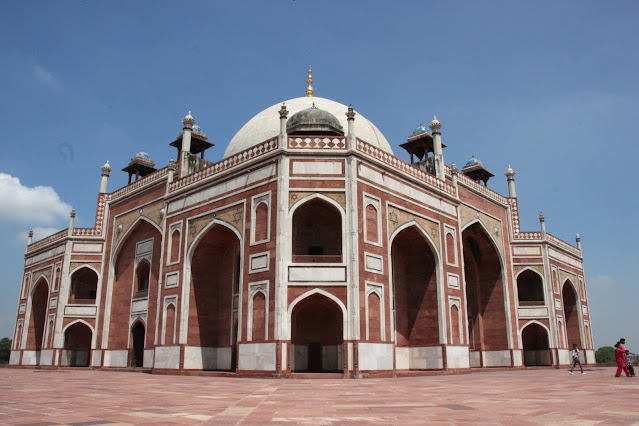
India Chronicles: Humayun’s Tomb - poetry etched in red stone

Image
Humayun's Tomb in New Delhi Walks down the lanes of history, most of the time, evoke some inexplicable feelings – awe and being a time warp. As much as the word ‘history’ tends to be associated with long texts in books and hardly a subject that kindles exuberance, a visit to any of the these landmarks kindles some of the emotions we spoke about. It was an era in the time of the Indian subcontinent’s history when there was a convergence of Persian influences in architecture. This imposing monument is tucked behind a façade of thick red stone walls. The Humayun’s Tomb, a magnificent structure in red stone, the pathway to which is lined with trees, in the midst of sprawling manicured lawns, the structure that unfolds before the eyes is opulent. The visitors can’t help but see the semblance to India’s most recognizable and iconic landmarks – the Taj Mahal. What many may not know is that Humayun’s Tomb, built in 1570, is the Indian subcontinent’s first garden-tomb and major architectura...

India Chronicles: Ellora Caves – spirituality carved on the hills

Image
The Indra Sabha, a part of the Jain caves at Ellora - Wikimedia Commons There is something about historical perspectives – they seldom cease to awe or intrigue us. As we talk of perspectives, the monuments across the world, from the pyramids in Egypt, the Great Wall of China, ancient cities of Rome and Athens, the mystique of Petra, are awe inspiring all. And then there is India, enriched and embedded in a civilization that is more than 4,000 years old, the length and breadth of the country is embedded with jewels of architecture, each with its unique characteristics and each having a story to relate. Ellora – home to a set of monasteries and temples, extending over more than two kilometres, is a far cry from the urban landscape of the city that never sleeps, India’s financial capital, Mumbai. It is encased in serenity and tells stories of three religions: Buddhism, Jainism, and Hinduism. Ellora Caves were carved out of massive rocks and mountain faces between 600 and 1100 AD. The site...

India Chronicles: Nalanda – the universe of knowledge

Image
Odantapuribs - Own work, CC BY-SA 4.0: Temple No.- 3 at Archaeological Site of Nalanda Mahavihara This is perhaps one of the oldest hubs of learning and knowledge known to mankind – with the distinction of being “one of the first great universities in recorded history” and a UNESCO World Heritage Site. Nalanda University, an hour’s drive from Patna, the capital of Bihar, according to historical accounts, was a centre of learning where scholars from far and wide came to enhance their knowledge. The long and illustrious life of the university lasted for 800 years – from the fifth to the 12th century CE. It is said that in the seventh century CE, the university accommodated more than 10,000 students and had 2,000 teachers. The university was considered an architectural marvel and had eight separate compounds with many classrooms. Built from red bricks, the university compound also had numerous lakes and parks. In the seventh century CE, Chinese monk Xuanzang gave a first-hand account of ...